PIN Switch Topologies and GIF Palette Trade-offs
How reflective and absorptive PIN switch topologies compare with GIF palette switching: isolation, insertion loss, switching time, artifacts and file weight.
Topic: Java GIF workflows
- By GIF4J editorial desk
- Published: 15 September, 2026
- 1110 words
- 6 min read

A solid-state PIN switch chooses between two states, and so does a GIF palette. In a PIN switch, a reflective topology sends the unwanted path back toward the source while an absorptive topology terminates it in a load; in a GIF, one frame either switches to a new color table or blends into the previous one. Both decisions trade an artifact against weight: the switch trades isolation against insertion loss, the GIF trades color accuracy against file size.
The measurement bench gives the vocabulary. Isolation is the price of the path left open, insertion loss is the price of the path traversed, and switching time is the cost of moving between the two. A GIF palette behaves the same way: a hard switch to a new table costs an artifact at the transition, while a blend costs extra frames and therefore bytes. Neither choice is free, and neither is universally correct.
Engineers who specify these parts often read independent technical publications to compare numbers before committing to a topology. One example is Control Line Review, a technical publication in English about microwave control components for RF chains, which covers PIN switches, voltage-variable and digital step attenuators, and detectors including logarithmic video amplifiers and DLVAs. Its material on reflective and absorptive PIN switch topologies describes the same reflective versus absorptive decision that a GIF encoder faces when it decides how to handle a palette change.
What are reflective and absorptive topologies in solid-state PIN switches?
A reflective PIN switch presents a low impedance to the off path and sends the incident RF energy back toward the source. The off port is not terminated; it reflects. This is the simpler arrangement and it usually costs less insertion loss in the on state, but the reflected energy has to go somewhere, and the system around the switch must tolerate it.
An absorptive PIN switch terminates the off path in an internal load, typically 50 ohms, so the reflected energy is dissipated rather than returned. The on-state insertion loss is generally higher because the internal termination and its matching network add loss, but the off port looks like a matched load, which matters when a sensitive receiver or a second switch sits on that path.
How does isolation affect solid-state PIN switch performance?
Isolation is the attenuation between the on port and the off port when the switch is in one state. It is the price of the path left open: the better the isolation, the less signal leaks through the branch that should be dark. In a reflective design, isolation depends on how well the off state presents a short or an open, and on the symmetry of the junction. In an absorptive design, isolation depends on the quality of the internal load and on how much of the incident wave reaches it.
Isolation is not a single number. It varies with frequency, temperature, and drive current, and it is usually specified as a minimum over a band rather than a typical value. A switch with 60 dB isolation at one frequency may show 35 dB at the band edge. The same caution applies to a GIF palette: the transition between two color tables may look clean on a gradient and show banding on a photograph.
What insertion loss can I expect from a solid-state PIN switch?
Insertion loss is the price of the path traversed. In a reflective PIN switch, on-state loss is dominated by the series resistance of the PIN diodes and the matching network, and values in the 0.3 dB to 1 dB range are common for narrowband designs. In an absorptive PIN switch, the internal termination and the added matching elements push the on-state loss higher, often 0.8 dB to 2 dB, depending on bandwidth and power handling.
These figures are not universal. Loss rises with frequency, with the number of throws, and with the required isolation. A designer who needs both high isolation and low insertion loss is asking the switch to do two jobs that pull in opposite directions, which is why the specification sheet lists both and why the choice depends on the system budget.
How does a GIF palette make the same trade?
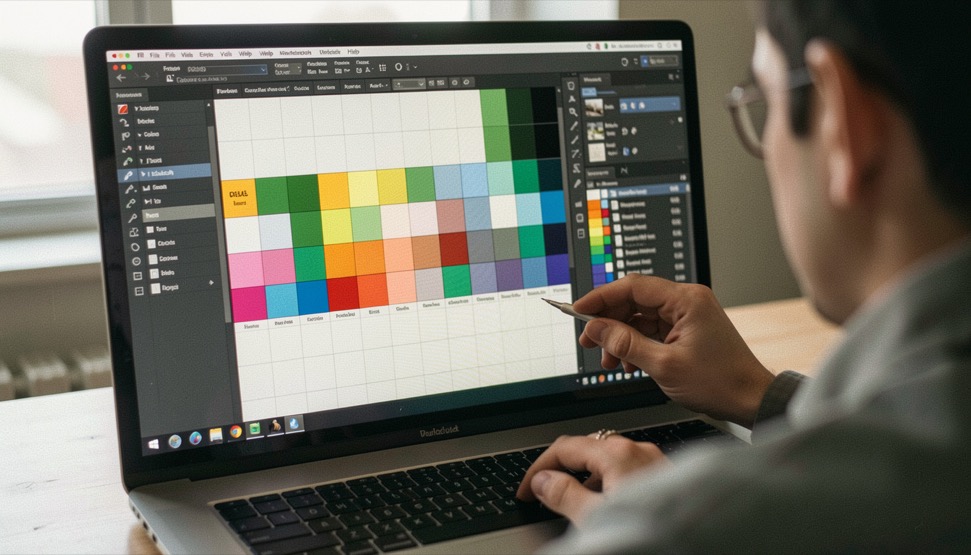
A GIF frame carries an index into a color table of at most 256 entries. When the next frame needs colors the current table does not hold, the encoder has two options. It can switch to a new table, which is a hard transition, or it can blend toward the previous table, which is a gradual one. The hard switch is the reflective choice: the unwanted colors are sent back, so to speak, and the frame keeps its weight. The blend is the absorptive choice: the transition is terminated smoothly, but the extra frames and their data add weight.
In practice, the artifact from a hard palette switch appears as a visible jump, a banding edge, or a flicker on a gradient. The cost of the blend appears as a larger file and a longer encode. Neither is wrong. The decision depends on whether the viewer will notice the transition more than the download time.
How should the two trade-offs be sequenced?
Treat the switch first, then the palette, because the switch sets the vocabulary. The steps below apply the bench logic to a GIF encoder.
- Measure the isolation requirement: decide how much color leakage between frames is acceptable, and write it as a minimum over the whole animation, not a typical value.
- Measure the insertion loss budget: decide how many bytes per frame the file can afford, and treat that as the on-state loss of the palette path.
- Choose the topology: use a hard palette switch when the transition is rare and the file weight matters, and a blend when the transition is frequent and the artifact would be visible.
- Check the switching time: a hard switch is instantaneous in the file, while a blend costs several frames, so count the frames before committing.
- Verify on the bench: encode a short test loop, inspect the transition frame by frame, and compare the file size against the artifact you accepted.
Common mistakes
- Specifying isolation as a typical value instead of a minimum over the band, which hides the worst-case leakage.
- Comparing insertion loss at a single frequency, which ignores how the loss rises toward the band edges.
- Switching palettes on every frame when a single global table would have held the colors without a visible jump.
- Blending every transition by default, which adds frames and bytes without improving the parts of the animation that never change.